
Roofing Company in Parker, TX
Phone
(214) 774-8818
Two waves
Collin County
Small town
wide lots
A town of two eras, with roofs from both on the same road
Parker has 1,625 homes and an unusual distribution: 23.9% of them went up in the 1970s, and another 34.6% in the 2000s. Driving through, that reads as older ranch houses on wide lots next to newer builds, and the roofs differ as much as the houses do. The median year built is 2004, so the newer half is heading into its first replacement while the 1970s half is on its second or third covering.

Homes in Parker: the local picture
Parker is a small town of 1,625 homes in Collin County, with a median year built of 2004 and two distinct waves: a 1970s core and a 2000s expansion. 34.8% of the stock predates 2000, so the two eras are close to evenly matched.
Median year built 2004, with a 1970s core behind it
The Census Bureau’s 2024 five-year estimate puts the median year built at 2004, with 26.5% of homes from the 2010s, 34.6% from the 2000s and 23.9% from the 1970s. A 1970s ranch on a wide lot has a low pitch, deep eaves and a deck that has been through fifty summers; a 2004 house has a steeper pitch and shingle that is now at the end of its first life.
Those two roofs need different answers, and the difference is not visible from the street. On the older house it is the deck and the metal. A visit that assumes one or the other wastes the homeowner’s time.
On a wide lot the older houses also carry garages and outbuildings that were roofed at the same time, and those planes are usually the first to fail.
Collin County hail on both eras
NOAA’s Storm Events database records 310 hail reports in Collin County between 2016 and 2025, on 62 days, with 63 reports at two inches or larger across 17 days and a county maximum of 5.25 inches. On a 1970s roof a stone finds brittle shingle; on a 2004 roof it usually leaves bruising that shows on the soft metal first.
The season runs March to June with a second window in September, and reporting density rises with population, so the county count measures exposure rather than a schedule. On a town this size, one hail day can involve a large share of the housing stock at once.
A 2004 roof has usually lost granule on the western planes, which is where the afternoon sun lands hardest on a lot without shade trees.
611 feet, and wide lots that leave the roof exposed
The USGS Elevation Point Query Service returns 611.8 feet at the Census Bureau’s point for Parker. Elevation is not a factor at that height, but exposure is. The granule layer protects the asphalt from ultraviolet light, and the Asphalt Roofing Manufacturers Association describes granule loss as the mechanism by which prolonged UV exposure degrades the shingle.
On a wide lot with few shade trees the sunward slope works all day, and the ridge takes the worst of it. That is why granule loss here tends to show first along the ridge and on the southern planes rather than evenly across the roof.
Shade is the variable here: a lot with mature trees ages a roof differently from an open one, and the difference shows on the same street.
Collin County, and a permit position that is not published
Parker sits in Collin County, and roof permits are handled by the town rather than the county. The town’s permits page lists forms for contractor registration, remodels and additions, and the fee schedule is based on square footage under roof for new and remodel work, with no re-roof line. The requirement is therefore not published in a form that can be quoted.
That is a reason to ask, not a reason to skip. Before work is scheduled, ask the town what it requires for the specific address, and get the answer for the address rather than for the town in general, because small-town practice often varies by lot and by plat.
The town’s fee schedule prices new and remodel work by square footage under roof, which is why the deck question and the permit question tend to arrive together on an older house.
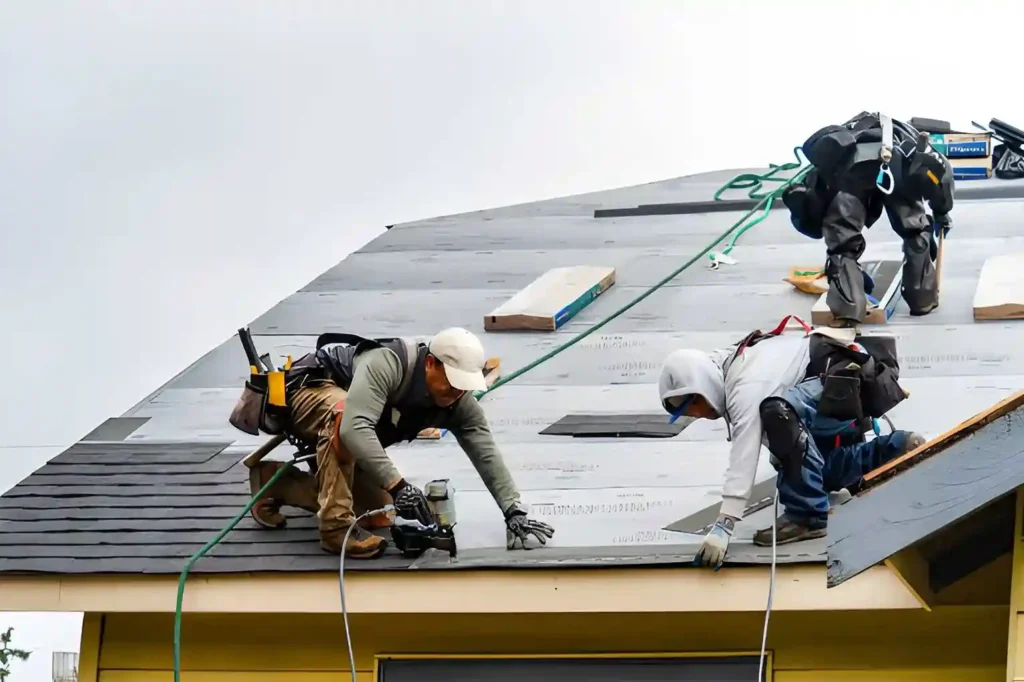
Roofing services in Parker, TX
Work here divides by era. A 1970s ranch usually needs a replacement that includes decking and metal; a 2004 house more often needs the shingle replaced on its first cycle, with the deck inspected while it is open. Both are decided by looking rather than by the year on the appraisal record.
A local failure — a valley, a boot, a step flashing — is a roof repair job, and on an older house the question is whether the deck around it is still sound. Where the shingle has gone brittle or bald across whole planes, roof replacement is the honest answer, and the scope covers the decking and the ventilation the house actually has.
After a hail day, storm and hail damage repair starts with the slopes and the soft metals. A roof inspection puts a condition record on a house before a sale or a renewal, and both eras here fall under residential roofing as a whole.
Between replacements, roof maintenance catches the cracked boot and the lifted cap before the next season does. On the 1970s houses that visit is also where soft fascia and a wavy gutter line get found early.
The two eras also differ in what a replacement includes. A 2004 house usually takes a shingle replacement with the deck inspected while it is open; a 1970s house often takes new decking at the eaves, new valley metal and new fascia before the shingle goes back on.
What both eras share is the deck question. A 1970s house usually needs carpentry at the eaves and new valley metal; a 2004 house usually needs shingle and boots, with the deck checked while it is open.
Two eras, one standard of work
Why homeowners in Parker choose this crew
A town with two eras of housing needs a visit that can read both, so the roof and the attic are looked at before anything is proposed: granule depth on the sunward planes, deck condition at the valleys, and whether the boots and flashings were built or merely sealed.
Those findings go in writing with photographs. On the 2004 houses the answer is usually a shingle replacement with the deck checked while it is open; on the 1970s houses it is often a replacement that includes carpentry. Both are named rather than assumed, and the crew comes up from Plano, which keeps a return visit practical.
On a two-era street the same visit can end in two different answers, and both are written down rather than assumed from the year on the appraisal record.
Why now, before another summer on either era
- The 2004 roofs are at the end of their first shingle life, and a replacement done before the deck is wet is a smaller job than one done after.
- Collin County hail runs March to June. A roof closed in the cooler months is inspected before the season that fills the calendar. A 1970s deck that has been wet for several seasons is the difference between a shingle job and a carpentry job.
- On the 1970s houses the deck and the fascia are the variables, and both are least costly to deal with while the roof is open. On a wide lot the western planes are the ones that show it first.
- Wide lots leave the sunward planes exposed all day, and heat is what turns a young shingle old before its rating suggests. On an open lot the western planes take the most sun, so they age first and read worst at a sale.
- The town's permit position has to be confirmed for the address, and that is easier to do before a crew is booked than during a storm week.
What a roof visit covers in a two-era town
- The attic, for deck staining, daylight at penetrations and the vent openings.
- The ridge and the sunward planes, where granule loss shows first. The outbuildings and garage roofs that share the house's shingle.
- Valleys and step flashings, checked by hand rather than from the ground. Both are checked by hand.
- Fascia and soffit behind the gutters on the older houses. The western planes, where the afternoon sun lands hardest.
- A written condition note with photographs, usable for a sale or a second opinion.

Frequently asked questions about roofing in Parker
Does a re-roof in Parker need a permit?
The town’s permits page lists contractor registration, remodel and addition forms, and its fee schedule covers square footage under roof for new and remodel work with no re-roof line, so the requirement is not published in a form that can be quoted. Ask the town about the specific address before work is scheduled and keep the answer with the house papers.
How old is the housing stock here?
The median house was built in 2004, with 1,625 homes split between a 1970s core (23.9%), the 2000s (34.6%) and the 2010s (26.5%), according to the Census Bureau’s 2024 five-year estimate. Just over a third of the stock predates 2000, which is why two roof eras meet on the same road. Ask which planes the quote covers, because a wide lot often has more roof than the front elevation suggests.
How much hail does the county record?
NOAA’s Storm Events file records 310 hail reports in Collin County between 2016 and 2025, on 62 days, with 63 reports at two inches or larger across 17 days and a county maximum of 5.25 inches. On an older roof the stone that matters is the one that lands on shingle that has already lost its flexibility. That record is also what a buyer’s inspector will read years later.
Can an older roof here be repaired instead of replaced?
Sometimes. A valley, a boot or a flashing on a roof with sound shingle is a repair. On a 1970s house the shingle is often brittle across the field, and a repair that opens the roof tends to find more than it was sent to fix. The deck condition is the honest dividing line, and it is visible from the attic before it is visible on the slope.
Does a 30-year shingle really last 30 years here?
The rating assumes maintained conditions. On a wide lot the sunward planes take ultraviolet light all day, and granule loss in the gutter is the practical measure of how much of the rating is left rather than the calendar.
Which county is Parker in?
Parker sits in Collin County, and roof permits are handled by the town rather than the county. The county matters for records and tax purposes; the town is who answers questions about a specific address.
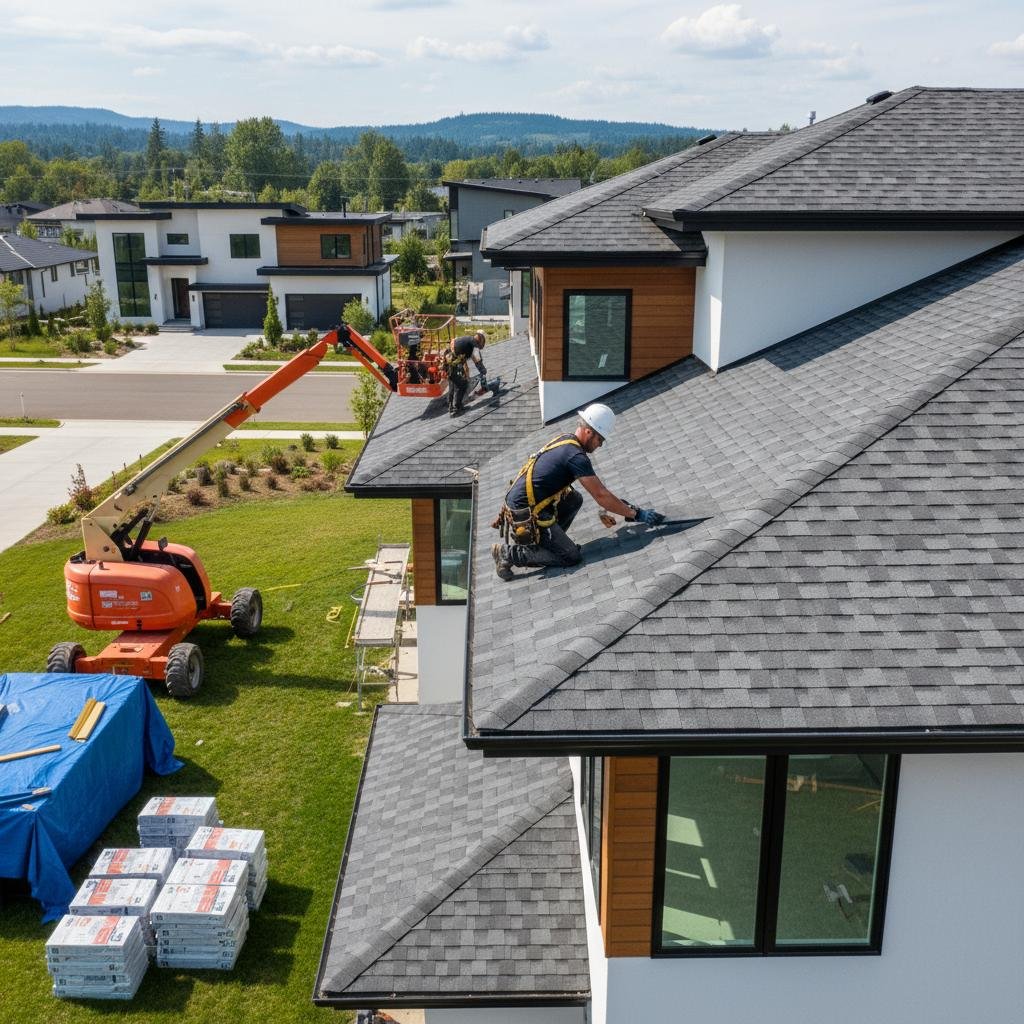
The permit question on a Parker roof
Parker does not publish a re-roofing requirement in a form that can be quoted here. The town’s permits page lists contractor registration, remodel and addition forms, and the fee schedule is based on square footage under roof for new and remodel work with no re-roof line. That is not a statement that no permit is needed, so the answer has to come from the town.
Ask about the specific address before the crew is booked, because small-town practice can vary by lot and by plat. Keep the answer, the permit number if one is issued, and the contractor’s registration with the house papers, so the next owner’s inspector has something to read.
Because the town prices new and remodel work by square footage under roof, the answer for a specific lot is worth having before the crew is booked.
Parker roofs, street by street
Next step: get a roof in Parker looked at
Call (214) 774-8818
Describe the leak and the year the house was built.
Say which era
A 1970s house and a 2004 house need different first questions.
Have roof and attic seen
Planes, ridge, valleys, boots and the deck.
Get the findings written
What is worn, what is sound, and where the deck is soft.
Ask the town about permits
The answer is taken for the address, not for the town.
Book the work
Roofing Repair Plano, 2715 Preston Meadow Dr, Plano, TX 75093.