
Roofing Company in Rowlett, TX
Phone
(214) 774-8818
Low ground
Dallas and Rockwall
1990s peak
first replacement
The lowest elevation in the group, and a 1990s roof stock
Rowlett sits at 459 feet, the lowest of the cities in this group, and its housing is dominated by the 1990s: the median house dates from 1997 and 27.7% of the stock went up in that decade. Those roofs are now approaching thirty years old, which is the end of a first shingle life, and the first replacement is the job being quoted on those streets.
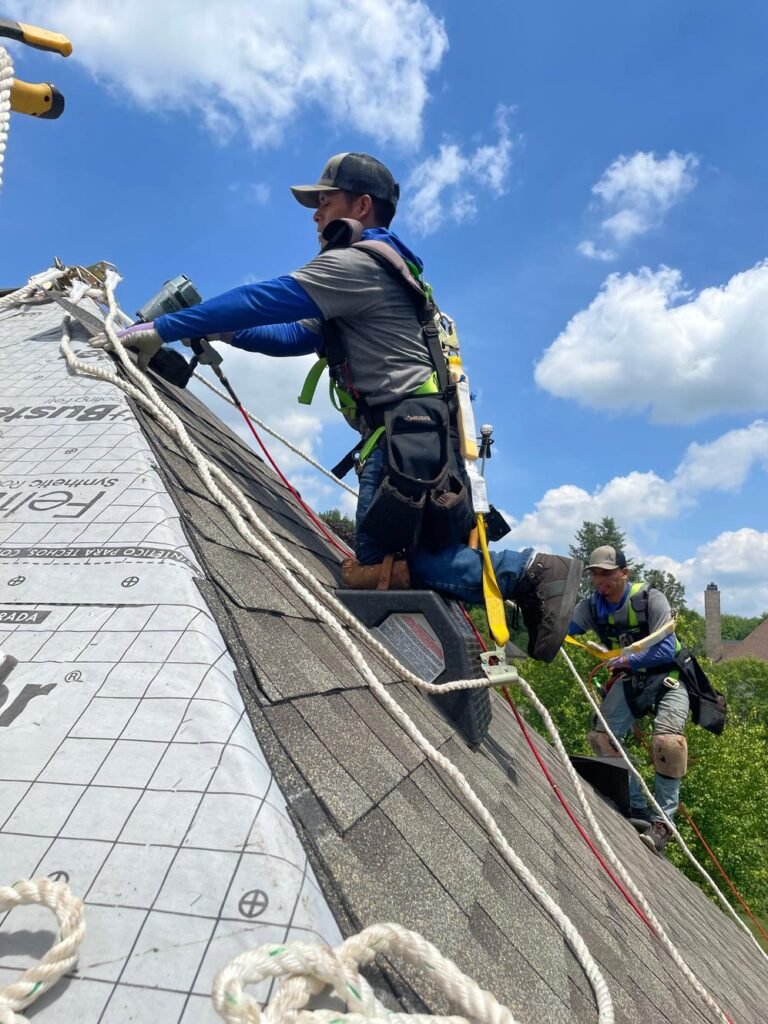
Homes in Rowlett: the local picture
Rowlett has 24,216 homes, a median year built of 1997 and 57.9% of its stock built before 2000. The city sits across Dallas County and Rockwall County, and its roof stock runs from 1980s streets to 2010s additions.
Median year built 1997, with a 1980s layer behind it
The Census Bureau’s 2024 five-year estimate puts the median year built at 1997, with 27.7% of homes from the 1990s, 19.8% from the 1980s and 20.8% from the 2010s. A house finished in 1997 was shingled with a twenty-five-year product, and the first replacement on those homes is what is being scoped now.
The 1980s houses are a step further along: many have been covered twice, and the deck underneath is the part that decides the scope. On the 2010s houses the shingle is young and the failures are details, which is a different job with a shorter schedule.
A 1990s house also carries the ventilation specified for its era, which is usually the minimum the code allowed at the time.
Dallas County hail on a first-replacement stock
NOAA’s Storm Events database records 196 hail reports in Dallas County between 2016 and 2025, on 64 days, with 23 reports at two inches or larger across nine days and a county maximum of 4.0 inches. Rowlett’s western portion sits in that county, and its eastern portion in Rockwall County.
Reporting density rises with population, so the count measures exposure rather than a schedule, and the season runs March to June with a second window in September. A roof at this age meets both windows. On a roof at the end of its shingle life, a two-inch stone is enough to turn a maintenance list into a replacement.
The two county portions share a hail record, so the address matters for paperwork rather than for exposure.
459 feet, and heat that works from underneath
The USGS Elevation Point Query Service returns 459.0 feet at the Census Bureau’s point for Rowlett, the lowest in this group. Elevation is not a factor at that height; the attic is. The granule layer protects the asphalt from ultraviolet light, and the Asphalt Roofing Manufacturers Association describes granule loss as the mechanism by which prolonged UV exposure degrades the shingle.
On 1990s housing the venting was sized to the code minimum of the time, and a blocked soffit intake makes the ridge exhaust useless. The result is a deck that stays hot and a shingle that ages from underneath, which is why two roofs of the same age on the same street can be years apart.
The attic is where a low-pitch 1990s roof shows its age first, because the deck stays warm and the shingle above it thins.
Two counties, and a re-roof permit with a registration form
Rowlett sits in Dallas County with a portion in Rockwall County, and roof permits are issued by the city rather than by either county. The city requires a permit for re-roofing, and a contractor registration form exists, though the roof-specific condition is not stated.
For a homeowner that means the permit question is answered by the city for the address, and the registration question is worth asking separately. Confirm both before the crew is booked, keep the permit number with the house papers, and ask which inspection applies to a re-roof in this city, since that decides when the roof can be closed.
The city requires a permit for re-roofing, so the paperwork is part of the job rather than an optional extra.

Roofing services in Rowlett, TX
Most of the work here is first-replacement work on 1990s housing, with a smaller share of repairs on the 2010s streets and on the 1980s houses that have been covered twice. The visit decides which of those a roof is, and the deck usually settles the scope.
A local failure — a valley, a boot, a step flashing — is a roof repair job, and on a 1997 house the question is whether the deck around it is still sound. Where the shingle has gone thin across whole planes, roof replacement is the honest answer, and the scope covers the decking and ventilation the house actually has.
After a hail day, storm and hail damage repair starts with the slopes and the soft metals. A roof inspection documents a roof before a sale or a renewal, and the city’s subdivisions fall under residential roofing as a whole.
Between replacements, roof maintenance catches the cracked boot and the lifted cap before the next season. On a roof this age that visit is also how a homeowner finds out whether the deck is still dry, which is the difference between a shingle job and a carpentry job.
Where a house is being sold, the inspection is the document that turns a question about roof age into a dated record, which is worth more than a verbal opinion in a town where most roofs are the same age.
On the 1980s houses, which have often been covered twice, the deck and the metal are the questions that decide the scope; on the 2010s additions the shingle is young and the failures are details.
Where a house is being prepared for sale, the inspection gives a seller something specific to say about roof age rather than a guess.
A first replacement, done once
Why homeowners in Rowlett choose this crew
On a 1997 roof the expensive mistake is buying shingle for a deck that should have come out, so the visit starts in the attic and works outward: staining at the deck, daylight at the penetrations, granule depth on the sunward planes, and the state of the valley metal.
Those findings go in writing with photographs before a scope is proposed. If the roof can take one more repair, that is the recommendation even though a replacement is the larger job. The crew comes out from Plano, which keeps a second look at a valley practical.
Because so many roofs here are the same age, the written record also gives a homeowner something to compare with the house next door, which is usually the most useful benchmark on the street.
On a street where most roofs are the same age, that written record is also the only way to tell a well-maintained roof from a merely repainted one.
Why now, with the 1990s roofs at the end of their life
- A roof from 1997 has passed its stated life, and the first replacement is cheaper before the deck is wet than after. A first replacement is also the chance to correct ventilation, which is least costly while the roof is open.
- Dallas County hail runs March to June. A roof closed in the cooler months is inspected before the season that fills the calendar.
- The city requires a permit for re-roofing and has a contractor registration form, so the paperwork belongs in the schedule rather than at the end of it. The city requires a permit for re-roofing, so the paperwork belongs in the schedule rather than at the end.
- Attic venting sized to a 1990s minimum keeps the deck hot, and heat is what ages a shingle from underneath.
- Matching a shingle that has been on a street for nearly thirty years gets harder each year, so a local repair is easier now than later. On the 1980s houses a second covering over a wet valley hides the water rather than stopping it.
What a roof visit covers on 1990s housing
- The attic, for deck staining, daylight at penetrations and the vent openings.
- The valleys, where a 1990s roof usually fails first. The deck at the valleys, where a second covering hides its problems.
- Boots and appliance vents, checked by hand rather than from the ground. The ridge and soffit openings, so the attic can actually exhaust.
- The sunward planes, for granule loss and hail bruising. The garage ceiling, which often shows the first stain from a valley above it.
- A written condition note with photographs, usable for a sale or a second opinion.
Frequently asked questions about roofing in Rowlett
Does a re-roof in Rowlett need a permit?
The city requires a permit for re-roofing, and a contractor registration form exists, though the roof-specific condition is not stated. Confirm both for the address before the crew is booked, and keep the permit number with the house papers. A first replacement is also the moment to correct ventilation, which is cheaper while the roof is open.
How old are the roofs here?
The median house was built in 1997 and 57.9% of the city’s 24,216 homes predate 2000, with 27.7% from the 1990s and 19.8% from the 1980s, according to the Census Bureau’s 2024 five-year estimate. Most of the city is on its original shingle or its second covering, which is why replacement work outnumbers repair work here and why the first quote on a street is usually followed by several.
How much hail does the county record?
NOAA’s Storm Events file records 196 hail reports in Dallas County between 2016 and 2025, on 64 days, with 23 reports at two inches or larger across nine days and a county maximum of 4.0 inches. The western part of the city sits in that county.
Can a 1997 roof be repaired instead of replaced?
Sometimes. A valley, a boot or a flashing on a roof with shingle left is a repair. At nearly thirty years the shingle is usually thin across the field, and a repair that opens the roof tends to find more than it was sent to fix. The deck condition is the honest dividing line.
Does a 30-year shingle really last 30 years here?
The rating assumes maintained conditions. In North Texas the variables are ultraviolet light, summer attic heat and hail, and granule loss in the gutter is the practical measure of how much of the rating is left rather than the calendar. The written record also gives a seller something specific to say about roof age. A first replacement is also the moment to correct ventilation, which is cheaper while the roof is open.
Which county is Rowlett in?
Rowlett sits in Dallas County with a portion in Rockwall County. Roof permits are issued by the city rather than by either county, so the county line matters for records and tax purposes more than for the work.
The permit and the registration on a Rowlett roof
Rowlett issues residential roof permits through the city, and re-roofing requires one. A contractor registration form also exists, though the roof-specific condition is not stated, so the registration question is worth asking separately from the permit question.
Ask both before the crew is booked, keep the permit number with the house papers, and confirm the current requirement with the city rather than relying on a contractor’s summary. On a first replacement the permit is also the record that fixes the date of the work.
Ask which inspection applies and keep the paperwork with the property records, because the next owner will ask for exactly that.
Keep the permit number, and any inspection report, with the house papers so a later owner has the record.
Rowlett roofs, street by street
Next step: get a roof in Rowlett looked at
Call (214) 774-8818
Describe the leak and the year the house was built.
Name the symptom
A ceiling stain, granules in the gutter or a lifted cap each point somewhere different.
Have roof and attic seen
Planes, valleys, boots and the deck above the living space.
Get the findings written
What is worn, what is sound, and where the deck is soft.
Settle permit and registration
Both are checked against the address before booking.
Book the work
Roofing Repair Plano, 2715 Preston Meadow Dr, Plano, TX 75093.
Rowlett Storm Record: Lake-Edge Wind and Spring Hail
Across the Dallas–Fort Worth metroplex, hail is a spring certainty rather than a surprise: the storm record averages roughly 17 to 18 hail days a year (2010–2025), no year in that span came in under ten, and about 88 percent of hail reports fall between March and June, with April the peak month. The busiest single day in the record, May 27, 2024, produced 118 hail reports across the metroplex; a week later the season was still going, and June 1, 2025 brought 76 reports with stones up to 3 inches. Rowlett adds a local factor most suburbs do not have: Lake Ray Hubbard. Homes on and near the peninsula meet storm wind with open water upwind of them, so gusts arrive unsheltered — the failure pattern we see after Rowlett storms is lifted shingle edges and creased tabs on the lake-facing slopes as much as hail strikes. Rowlett’s roughly 21,500 households make it one of the larger communities we cover, and its roofs take the full March-to-June season every year. If a storm has crossed the lake toward your street, a dated inspection with photographs is the useful next step. Call us on (214) 774-8818.