
Roofing Company in Addison, TX
Phone
(214) 774-8818
Small and dense
Dallas County
Attached homes
shared roof planes
A small, dense town where roofs are shared
Addison is 11,369 homes, and a large share of them are attached: townhomes and small multifamily buildings where one roof plane covers more than one address. The median house dates from 1998, so the stock is at the end of its first shingle, and the complication here is less the age than the fact that a repair decision is often a shared one.

Homes in Addison: the local picture
Addison has 11,369 homes, a median year built of 1998 and 54.3% of its stock built before 2000. Attached housing and commercial roofs share space with single-family streets, which is what shapes the roof work here.
Median year built 1998, and a quarter from the 2010s
The Census Bureau’s 2024 five-year estimate puts the median year built at 1998, with 24.4% of homes from the 1990s, 17.7% from the 1980s and 24.0% from the 2010s. The 1990s housing is now at the end of a first shingle life, while the 2010s buildings are young enough that a leak is usually a detail.
The difference that matters here is ownership of the roof plane. On an attached row, one slope and one valley can serve three or four addresses, so a repair has to be scoped to the whole plane rather than to the unit that reported the stain.
On a 1998 attached row the shingle on every unit was installed in the same month, so the plane reaches the end of its life as one roof rather than several.
Dallas County hail across shared planes
NOAA’s Storm Events database records 196 hail reports in Dallas County between 2016 and 2025, on 64 days, with 23 reports at two inches or larger across nine days and a county maximum of 4.0 inches. On a shared roof plane, a hail day is a conversation between neighbours rather than a single household’s decision.
Reporting density rises with population, so the count measures exposure rather than a schedule, and the season runs March to June with a second window in September. The practical check after a storm here is the ridge, the valleys and the soft metal on the shared planes.
That is also why a hail inspection here is a building conversation, and why the findings are written for an HOA rather than for one household.
640 feet, and heat between two rows
The USGS Elevation Point Query Service returns 640.1 feet at the Census Bureau’s point for Addison. Elevation is not a factor at that height; spacing and summer heat are. The granule layer protects the asphalt from ultraviolet light, and the Asphalt Roofing Manufacturers Association describes granule loss as the mechanism by which prolonged UV exposure degrades the shingle.
On a dense street the roof gets sun for most of the day and shade for little of it, and a small attic under a low-slope section can run hotter than a larger one. That is why the south-facing planes and the attic are both read before a scope is proposed.
A small attic under a low-slope section can run hotter than a larger one, which is why the attic is read before the slope.
Dallas County, and a permit for shingle replacement
Addison sits in Dallas County, and roof permits are issued by the town. The town’s development services guidance treats re-roof shingle replacement as permitted work, and contractors register and renew through the town’s CSS portal, with inspections scheduled through the same system. That is also why the written scope names the plane rather than the unit.
For a homeowner in an attached building the practical question is who is the applicant: on a shared roof the answer is usually the HOA or the building owner rather than one unit. Confirm the requirement with the town for the address, and keep the permit number with the building records.
Because the town treats shingle replacement as permitted work, the paperwork follows the plane rather than the unit.

Roofing services in Addison, TX
Work in this town divides between single-family repairs on young housing and shared-plane work on attached rows and small multifamily buildings. The second category needs a scope that covers the whole plane, because a patch on one unit rarely matches the rest of the slope.
A local failure — a valley, a boot, a step flashing — is a roof repair job, and on 1990s housing the question is whether the deck around it is sound. Where a plane has gone thin across its length, roof replacement is the honest answer, and on an attached row it is scoped to the plane rather than to the unit.
After a hail day, storm and hail damage repair starts with the ridge, the valleys and the soft metal. A roof inspection documents a building before a sale or a renewal, and both the single-family streets and the attached rows fall under residential roofing.
Between replacements, roof maintenance catches the cracked boot and the lifted cap before the next season. On a shared plane that visit is also how a building keeps one record for the whole roof rather than one per address.
On a shared plane the scope is written for the building: which slope, which valley, and which addresses it serves. That is the document an HOA can approve without a second meeting.
Where a building is being sold, the inspection is also the record that separates a maintained roof from a patched one, which is the question a buyer’s inspector asks first.
There is also a records question on attached housing: one roof, several addresses, and often one HOA file. Keeping the permit, the photographs and the repair history in one place is what makes the next decision faster.
One plane, one scope
Why homeowners in Addison choose this crew
On an attached row the expensive mistake is patching one unit’s ceiling and leaving the rest of the plane to fail in sequence, so the visit walks the whole plane: the ridge, the valleys, the boots and the soft metal, plus the attic above each address it serves.
Those findings go in writing with photographs, which is what an HOA or a building owner needs before approving work. If the plane can take a repair, the recommendation is a repair even though a replacement is the larger job. The crew comes up from Plano, which keeps a second look at a shared valley practical. On a building with several addresses, that record is the useful part of the visit.
A written scope for the whole plane is also what keeps a shared roof from being repaired twice in two years, once per unit.
Why now, with the 1990s roofs at the end of their life
- A 1998 roof has passed its first shingle life, and on a shared plane the whole slope ages at the same rate rather than one unit at a time. A written scope for the plane is also what an HOA needs before it can approve anything.
- Dallas County hail runs March to June. A plane closed in the cooler months is inspected before the season that fills the calendar. On a shared plane the whole slope ages at once, so the first stain is usually a warning about every address under it.
- The town treats re-roof shingle replacement as permitted work, so the paperwork belongs in the schedule rather than at the end of it.
- On a dense street the roof gets sun all day and the attic runs hot, and heat is what ages a young shingle early. Matching shingle across a row is easier while the original profile is still available.
- Matching shingle across an attached row is easier while the original profile is still available than after it is discontinued. A small attic under a low-slope section runs hot, and heat is what ages the shingle before its time.
What a roof visit covers on a shared plane
- The whole plane, not only the unit that reported the stain. The soft metal on the shared plane, where hail marks are easiest to read.
- The attic above each address the plane covers, for deck staining and daylight. The low-slope sections, where water sits longest on a dense street.
- Ridge caps and valleys, where water and wind do the first damage. The party wall, where two addresses meet under one roof.
- Boots, flues and any commercial unit sharing the same roof. The transition at a party wall, where two addresses meet under one roof.
- A written note with photographs, usable for an HOA or a building owner.

Frequently asked questions about roofing in Addison
Does a re-roof in Addison need a permit?
The town’s development services guidance treats re-roof shingle replacement as permitted work, and contractors register and renew through the town’s CSS portal, with inspections scheduled through the same system. On an attached building the applicant is usually the HOA or the owner rather than one unit, so confirm that with the town for the address. The written scope is what an HOA approves, so it names the plane rather than the unit. Ask who the applicant is, because on an attached row it is rarely one household.
How old is the housing stock here?
The median house was built in 1998 and 54.3% of the town’s 11,369 homes predate 2000, with 24.4% from the 1990s and 24.0% from the 2010s, according to the Census Bureau’s 2024 five-year estimate. The 1990s housing is at the end of its first shingle life. The inspection record follows the building rather than one address. One record for the building is worth more than one per address.
How much hail does the county record?
NOAA’s Storm Events file records 196 hail reports in Dallas County between 2016 and 2025, on 64 days, with 23 reports at two inches or larger across nine days and a county maximum of 4.0 inches. On a shared plane that is a neighbour-level event rather than a household one.
Can a shared roof be repaired rather than replaced?
Sometimes, and the plane decides. A boot, a valley or a ridge cap on a plane with shingle left is a repair. Where the plane has thinned along its length, a repair to one section leaves the rest to fail in sequence, and the whole plane is the honest scope.
Does a 30-year shingle really last 30 years here?
The rating assumes maintained conditions. In North Texas the variables are ultraviolet light, summer attic heat and hail, and on a dense street the sunward plane works all day. Granule loss in the gutter is the practical measure of what is left.
Which county is Addison in?
Addison sits in Dallas County, and roof permits are issued by the town rather than the county. The county matters for records and tax purposes; the town is who answers questions about a specific address.
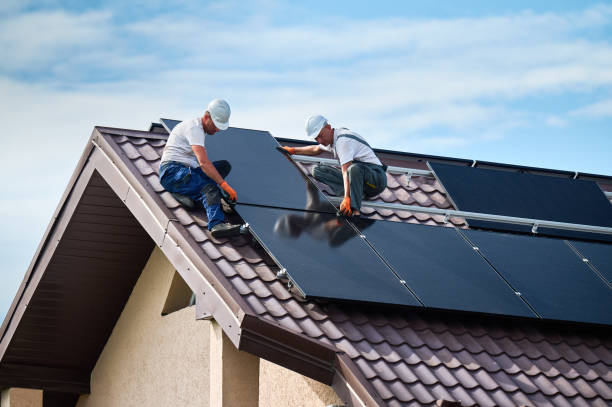
The permit and the applicant on an Addison roof
Addison issues roof permits through its development services department, and re-roof shingle replacement is treated as permitted work. Contractors register and renew through the town’s CSS portal, and inspections are scheduled through the same system, which keeps the record attached to the address.
On an attached building the applicant is usually the HOA or the building owner, so the permit question is also a question about who speaks for the roof. Confirm that with the town before the crew is booked, keep the number with the building records, and ask which inspection applies to a shared plane.
Ask which inspection applies and keep the number with the property records, because the next owner will ask for exactly that.
Addison roofs, street by street
Next step: get a roof in Addison looked at
Call (214) 774-8818
Describe the leak and the year the building was constructed.
Say who owns the roof
On an attached row the honest scope covers the whole plane.
Have the plane and attic seen
Ridge, valleys, boots and the deck above each address.
Get the findings written
What is worn, what is sound, and what the HOA needs to read.
Settle the permit and applicant
The town is asked who applies for the address.
Book the work
Roofing Repair Plano, 2715 Preston Meadow Dr, Plano, TX 75093.