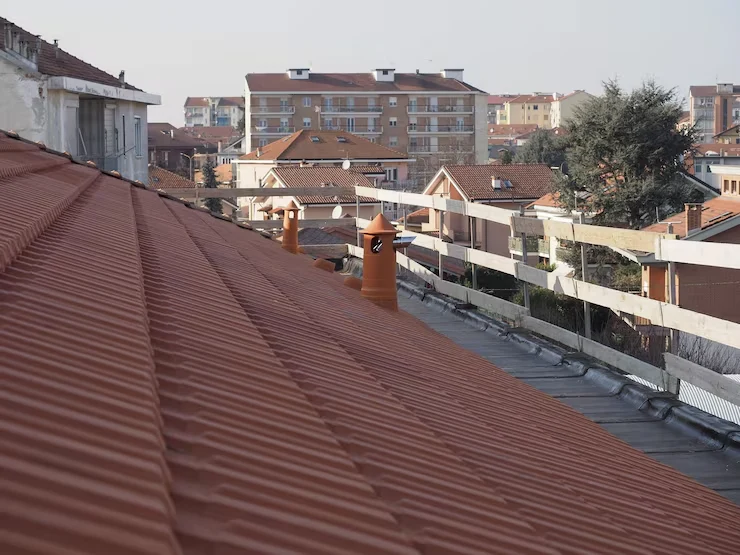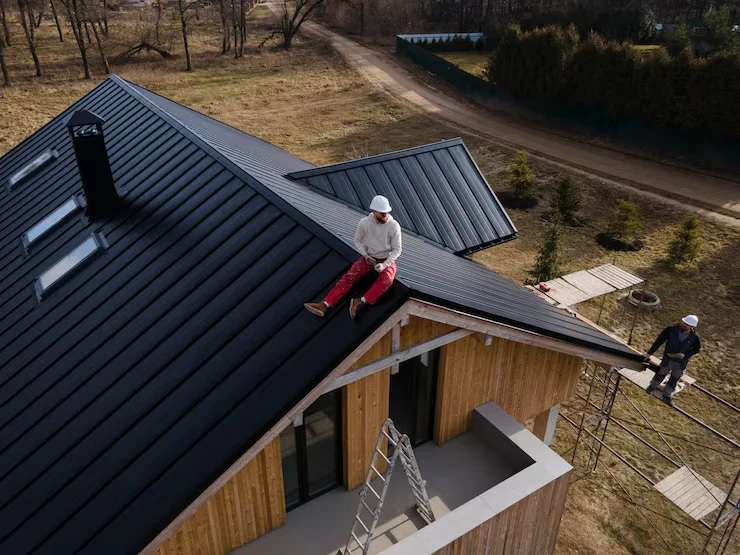
A modified bitumen roof is the asphalt-based option for flat and low-slope sections, and on many older Plano homes it is what covers the porch, the carport or the flat roof of an addition. It usually has a gritty, granule-covered surface, which is why it is often mistaken for rolled shingle roofing.
This guide explains how modified bitumen works, how its two main types differ, how it is installed, and the problems that show up most often. It relies on what manufacturers and the building code publish. There are no prices here, and no lifespan figure appears without a source.
What is a modified bitumen roof?
A modified bitumen roof is a flat or low-slope roof covering made from asphalt that has been blended with a polymer to make it more flexible and durable. It comes in rolls with a reinforcing mat inside, and it is usually installed in two or more layers, with a granule-surfaced cap sheet on top.
“Bitumen” is the roofing industry’s word for asphalt. Adding a polymer to it is the “modification”. Johns Manville, a major manufacturer, describes its SBS modified bitumen as engineered specifically for elasticity, and its APP modified bitumen as an APP polymer and asphalt blend with weathering resistance, flexibility and dimensional stability.
The building code treats it as its own roof type. Plano has adopted the 2024 International Residential Code through Ordinance 2025-6-15. The 2024 IRC text, shown on UpCodes, has a separate section, R905.11, for modified bitumen roofing.
Our guide to roofing materials for Plano homes shows where it sits alongside shingles, metal and single-ply membranes.
What is the difference between bitumen and modified bitumen?
Plain bitumen is asphalt on its own. Modified bitumen is asphalt blended with a polymer, usually SBS or APP, and reinforced with a fibreglass or polyester mat. Manufacturers add the polymer for elasticity, flexibility and weathering resistance. That added flexibility is the point of the product.
Johns Manville’s product pages describe the two polymer families. SBS stands for styrene butadiene styrene, a rubber-like polymer that JM says is engineered for elasticity. APP stands for atactic polypropylene, a plastic polymer that JM blends with asphalt for weathering resistance and dimensional stability.
The reinforcement matters too. In a Johns Manville article on reinforcements for modified bitumen, the manufacturer says the mat plays a key role in tensile strength, tear strength, elongation, dimensional stability and thickness. It says fibreglass mats are associated with dimensional stability and tensile strength, while polyester mats are associated with strength, flexibility and tear resistance.
What are the types of modified bitumen membranes?
There are two main types of modified bitumen membrane, named after their polymer: SBS and APP. Within each, products differ by reinforcement, surfacing and installation method. A typical system has a base sheet and a granule-surfaced cap sheet, sometimes with an interply between. The combination is chosen for the roof, the climate and the crew’s method.
| Feature | SBS modified bitumen | APP modified bitumen |
|---|---|---|
| Polymer | Styrene butadiene styrene | Atactic polypropylene |
| What JM stresses | Elasticity | Weathering and dimensional stability |
| Installation methods named by JM | Cold applied, heat weld, self-adhered, mechanically fastened, hot applied | Heat weld (torch) applied |
| Typical surface | Granule cap sheet | Granule cap sheet |
Johns Manville says SBS is the most customisable of its low-slope products and can be installed by cold-applied, heat-welded, self-adhered, mechanically fastened and hot-applied methods. It describes its APP products as heat-weld applied membranes, including base sheets for multi-ply roofs and granule-surfaced cap sheets.
Does modified bitumen need felt underneath? It is normally laid as a system, with a base or ply sheet under the cap sheet rather than roofing felt alone. CertainTeed, in its guide to self-adhered modified bitumen, recommends mechanically attaching an anchor sheet to a wood deck before self-adhering the plies above it.
How is a modified bitumen roof installed on a house?
A modified bitumen roof is installed in layers: an anchor or base sheet fixed to the deck, then one or more plies, then a cap sheet, with every lap sealed by heat, hot asphalt, cold adhesive or a self-adhesive backing. The method matters on a house, because torch application brings open flame close to wood framing.
CertainTeed says traditional low-slope methods using mopped asphalt or torch welding come with application constraints and safety considerations, and can generate fumes. It presents self-adhered SBS systems as a cleaner alternative. That is a manufacturer promoting its own product line, but the safety point about open flame on a wood-framed house is worth raising with any installer.
CertainTeed also gives a rule of thumb for residential self-adhered work: plywood decks at least 1/2 inch thick, or OSB decks at least 7/16 inch thick, each with a minimum slope of 1/4 inch per foot.
The code sets the slope floor too. The 2024 IRC says modified bitumen roofing shall have a design slope of not less than one-fourth unit vertical in 12 horizontal for drainage. A section that is level, or that has sagged, needs its slope corrected, not just a new cap sheet.
All of this is work for a roofing crew with fall protection. Do not go onto a flat roof to inspect it; look from a window above it or check the ceiling below for stains.
Which problems show up most on modified bitumen roofs?
Three common problems with modified bitumen roofs are laps that let go, granule loss from the cap sheet, and damage from foot traffic in hot weather. Ponding water from poor slope is a fourth. CertainTeed lists the first three as quality questions every contractor should ask about a product before choosing it.
In its guide, CertainTeed tells contractors to ask how well a product handles these issues:
- Laps that delaminate. Can the adhesive withstand expansion and contraction stresses without delaminating, specifically at sidelaps, endlaps and details? A lap that lets go is a path for water.
- Granule loss. How well are granules retained on the cap sheet? Bare patches on the cap sheet are worth reporting to a roofer.
- Scuffing in heat. Does the product scuff or compress from foot traffic in hot weather? Hot North Texas afternoons make that question relevant here.
CertainTeed adds a fourth limitation for self-adhered products: it becomes difficult to achieve full bond strength as temperatures drop below 40 degrees Fahrenheit. A self-adhered roof installed on a cold day may not bond fully unless the method allows for it.
Ponding is the other common issue. The code requires a quarter-inch-per-foot design slope because water that cannot drain sits on the surface and finds any weak lap. Our guide to ponding water on flat roofs explains what standing water means and when to call for help.
How much foot traffic can modified bitumen take?
A modified bitumen roof is built to take some foot traffic, and CertainTeed says its multi-layer self-adhered systems are less susceptible to puncture from foot traffic than thinner single-ply membranes. But walking on any flat roof is a job for a professional, and in strong sun the surface can scuff or compress.
CertainTeed says most self-adhered modified bitumen systems range from 180 to 380 mils thick, compared with 40 to 80 mils for TPO single-ply. It sells modified bitumen, so read that as a manufacturer’s comparison, but the thickness difference is real and is the reason the material tolerates more traffic.
For a homeowner, the advice is simple. Stay off it. A flat porch roof often has no edge protection, and the drop is enough to cause serious injury. Leave inspections to a roofer, and if you must look, look from a window or from the ground.
Modified bitumen vs TPO: which suits the flat part of a house?
Modified bitumen is thicker, asphalt-based and usually multi-layer, with a granule surface. TPO is a thin, white, single-ply plastic sheet with heat-welded seams. Modified bitumen tolerates traffic better; TPO reflects more sun in its standard white form. The right choice depends on the section’s use, sun exposure and the installer’s skill with each.
| Feature | Modified bitumen | TPO |
|---|---|---|
| Base material | Polymer-modified asphalt | Thermoplastic polyolefin |
| Layers | Usually two or three | Single ply |
| Thickness cited by CertainTeed | 180 to 380 mils (self-adhered) | 40 to 80 mils |
| Usual surface | Granules | Smooth white |
| Seams | Heat, hot asphalt, cold adhesive or self-adhered | Hot air welded |
Heat is the local factor to weigh. CertainTeed lists cool roof surfacing among the options for self-adhered systems, so a granule surface does not have to be dark. Plano’s energy code, adopted as Ordinance 2025-6-10, writes its local insulation amendments for Climate Zone 3, so ask how insulation is handled if the section covers a living space.
Our guide to TPO roofing for the flat parts of a house covers the white membrane option, its seams and its honest drawbacks.
How long does a modified bitumen roof last?
No independent source we fetched gives a measured lifespan for modified bitumen on homes. CertainTeed says the formula for its SBS-modified asphalt has remained unchanged for over 40 years, but that describes the product’s history, not how long a roof lasts. Drainage, laps, granule cover and installation quality decide the life of a section.
The useful step is to ask for the warranty in writing, for the exact system being installed. Check whether it covers the membrane only or the whole system, and whether the installer covers workmanship separately. Ask how laps and flashing will be checked before the crew leaves.
Hail is part of the picture here. According to the NOAA Storm Events Database, the Plano area logged 310 hail reports on 62 separate days between 2016 and 2025. CertainTeed lists impact resistance as one of the options available in self-adhered products, so ask whether the cap sheet quoted has an impact rating.
What should you ask before repairing or replacing modified bitumen?
Ask whether the roof is SBS or APP, how it will be installed and whether open flame will be used, how the laps and flashing will be made, and how water will drain. For a repair, ask the roofer to confirm the membrane first. Those answers decide how long the work lasts.
A short checklist:
- Is the existing roof modified bitumen, and is it SBS or APP?
- Will the new system be torch-applied, hot-mopped, cold-applied or self-adhered?
- How many plies, and which cap sheet, by product name?
- Does the section meet the code minimum slope, and where does water go?
- Will the roofer pull the permit? In Plano, Ordinance 2025-6-15 requires a contractor to be registered with the city to obtain one; homeowners may pull permits for their own residence.
If you have a flat section that needs a repair or a new roof, Roofing Repair Plano can help through our flat and commercial roofing service.
Frequently asked questions
What are the different types of modified bitumen membranes?
The two main types are SBS, which uses a rubber-like styrene butadiene styrene polymer, and APP, which uses atactic polypropylene. Johns Manville describes SBS as engineered for elasticity and installable several ways, and APP as heat-weld applied. Both come with fibreglass or polyester reinforcement and usually a granule-surfaced cap sheet.
What is the difference between bitumen and modified bitumen?
Bitumen is asphalt. Modified bitumen is asphalt blended with a polymer, SBS or APP, and reinforced with a mat. The polymer makes the sheet flexible and better able to handle heat and cold. Johns Manville says the reinforcement also shapes tensile strength, tear strength and dimensional stability.
What are three common problems on modified bitumen roofs?
CertainTeed tells contractors to check whether laps resist delaminating at sidelaps, endlaps and details, whether the cap sheet retains its granules, and whether the surface scuffs or compresses under foot traffic in hot weather. Ponding from poor slope is another common problem. The 2024 IRC requires a quarter-inch-per-foot design slope.
Can you walk on a modified bitumen roof?
It is built to tolerate some foot traffic, and CertainTeed says its thicker multi-layer systems resist puncture better than thin single-ply membranes. Walking on any flat roof is still a job for a professional with fall protection. In hot weather the surface can scuff or compress, so even roofers limit traffic.